

Choosing a Maryland business mediator comes down to five questions: experience and case volume, credentials and court approvals, process and methodology, availability and scheduling, and track record with similar disputes.
A mediator’s answers to these questions reveal whether they can handle a specific business dispute or whether their experience lies elsewhere.
Parties who ask all five before scheduling can reduce the risk of mismatched expectations and wasted session time. Business owners weighing options can schedule a mediation consultation to ask these questions directly before committing to a mediator.
Earl J. Acquaviva, Jr. answers all five questions directly during a free consultation — schedule a mediation to compare experience and approach before hiring.
Case volume and industry background separate a generalist mediator from one who understands the specific commercial context of a dispute. A mediator who has handled partnership disputes, shareholder conflicts, or vendor breakdowns brings pattern recognition that a first-time business mediator cannot offer.
Earl J. Acquaviva, Jr. has mediated business and contract disputes across all Maryland Circuit Courts since 2012, following more than three decades as Senior Vice President, General Counsel, and Chief Litigation Officer of Bally Total Fitness Corporation, where he managed commercial disputes for a company operating over 400 locations across 29 states and Canada.
That corporate litigation-management background gives him direct experience evaluating business dispute exposure before a case ever reaches mediation.
Maryland sets no formal certification requirement to practice as a private mediator, but circuit court roster approval requires meeting specific standards.
Under Maryland Rule 17-205(a), a mediator seeking general circuit court approval must complete at least 40 hours of basic mediation training, have mediated or co-mediated at least two civil cases, agree to follow the Maryland Standards of Conduct for Mediators, and complete four hours of continuing education annually.
Business and Technology mediator status requires more. Under Maryland Rule 17-205(b), a mediator must meet the general Rule 17-205(a) qualifications and have mediated or co-mediated at least five non-domestic civil cases within the two years preceding the application, including at least two cases assigned to the Business and Technology Case Management Program.
Acquaviva holds this Business and Technology mediator approval in all Maryland Circuit Courts, in addition to his general civil roster approval, and maintains active standing in the Maryland Program for Mediator Excellence, which requires ten hours of continuing education annually and adherence to the Maryland Standards of Conduct for Mediators.
Rates and assignment procedures vary by circuit court and case type. Parties who find a court-appointed mediator unsuitable may request substitution under Maryland Rule 17-202.
| Feature | Court-Designated Mediator | Privately Selected Mediator |
| How Assigned | Appointed by the circuit court from its approved roster, subject to substitution requests under Rule 17-202 | Chosen directly by the parties, with or without a pending case |
| Minimum Qualification | Maryland Rule 17-205(a) — 40 hours training, 2 mediated cases | No formal certification requirement in Maryland |
| Hourly Rate | Reduced rate set by the individual circuit court; rates vary by court and case track | Set independently by the mediator |
| Specialty Roster Option | Business and Technology roster under Rule 17-205(b), where applicable | Any specialization the mediator markets directly |
A mediator’s process determines how efficiently a session moves toward resolution. Ask whether the mediator opens with ground rules and uninterrupted opening statements, uses private caucuses to explore settlement positions individually, or relies primarily on joint sessions.
Acquaviva opens every session by presenting his credentials and establishing procedural ground rules, then moves between private caucuses and joint sessions depending on what each dispute requires.
His approach identifies the core interests on both sides before testing a realistic range of outcomes — the same framework he built managing employment and commercial disputes at Bally Total Fitness.
Parties should confirm that this level of structure exists before scheduling; in Acquaviva’s professional judgment, an unstructured session risks wasting the mediator’s billable time without producing progress.
Scheduling flexibility affects how quickly a business dispute reaches resolution. Ask whether sessions are available in person, by Zoom, or both, and how far out the mediator’s calendar typically runs for a new class action or multi-jurisdictional matter versus a routine single-session dispute.
Acquaviva holds sessions at his Kingsville office or by Zoom, Monday through Friday, 9:00 a.m. to 5:00 p.m. Eastern, and offers free initial consultations to discuss scheduling before a party commits to a session.
Multi-state and multi-party disputes typically require coordinating each party’s calendar across time zones, so confirming a mediator’s availability for follow-up sessions matters as much as confirming the first appointment.
Rather than asking for a numeric success rate, ask a prospective mediator to describe their experience with the specific dispute category at hand — partnership disputes, vendor breakdowns, shareholder conflicts, or intellectual property disagreements.
Maryland’s mediation confidentiality rules under Title 17 protect mediation communications from disclosure, which limits how mediators can ethically discuss outcomes in specific past matters, and case-by-case variability further limits the meaningfulness of a single success-rate figure.
Acquaviva discusses his relevant case history for a specific dispute type directly during a consultation, drawing on both his Maryland Circuit Court caseload since 2012 and his corporate litigation-management background at Bally Total Fitness.
In Acquaviva’s view, a mediator’s willingness to speak candidly about relevant — and irrelevant — experience is itself a signal of professional judgment.
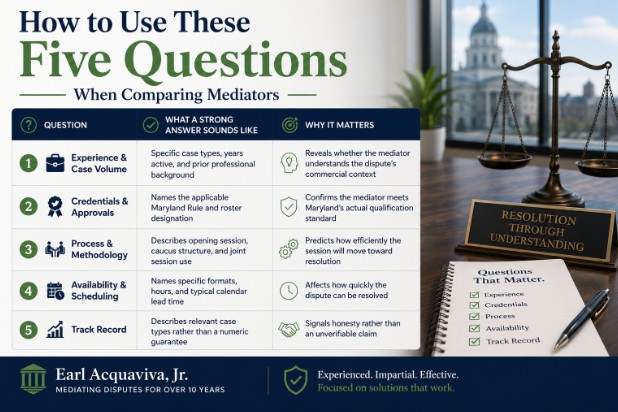
| Question | What a Strong Answer Sounds Like | Why It Matters |
| Experience & Case Volume | Specific case types, years active, and prior professional background | Reveals whether the mediator understands the dispute’s commercial context |
| Credentials & Approvals | Names the applicable Maryland Rule and roster designation | Confirms the mediator meets Maryland’s actual qualification standard |
| Process & Methodology | Describes opening session, caucus structure, and joint session use | Predicts how efficiently the session will move toward resolution |
| Availability & Scheduling | Names specific formats, hours, and typical calendar lead time | Affects how quickly the dispute can be resolved |
| Track Record | Describes relevant case types rather than a numeric guarantee | Signals honesty rather than an unverifiable claim |
Rising litigation costs make the mediator selection decision worth this scrutiny — scheduling a mediation consultation provides direct answers to all five questions at once.
What should I ask a business mediator before hiring them in Maryland? Ask about case volume and industry experience, credentials and court roster approvals, mediation process, scheduling availability, and track record with disputes similar to the case at hand. A mediator who answers all five clearly is easier to evaluate than one who gives generic responses.
Does a mediator need to be a lawyer to mediate business disputes in Maryland? Maryland does not require mediators to be licensed attorneys. Circuit court roster approval under Rule 17-205(a) requires 40 hours of training and two mediated cases regardless of legal background, though many business mediators, including attorneys, bring litigation experience that informs their approach to commercial disputes.
What is a Maryland Business and Technology mediator? A Business and Technology mediator is approved under Maryland Rule 17-205(b) to handle Business and Technology Case Management Program cases. Qualification requires meeting the general Rule 17-205(a) standards and having at least five non-domestic civil mediations within two years, including two Business and Technology matters.
How do I verify a mediator is approved by a Maryland Circuit Court? Maryland Circuit Courts maintain approved mediator rosters under Title 17 of the Maryland Rules, and prospective mediators must submit application forms and supporting documents to the clerk of each circuit court. Parties can confirm roster status by contacting the specific circuit court or the mediator.
Should I choose a court-appointed mediator or select my own? Court-appointed mediators are assigned from the circuit court’s roster at a rate set by the individual court. However, parties who find the assignment unsuitable may request a substitution under Maryland Rule 17-202. Privately selected mediators, including those from a court’s own roster, allow parties to match a mediator’s background directly to the dispute type.
What continuing education do Maryland mediators complete? Circuit court roster mediators complete four hours of continuing education annually under Rule 17-205(a). Maryland Program for Mediator Excellence members commit to 10 hours annually — 8 skills hours and 2 ethics hours — and to adherence to the Standards of Conduct for Mediators.
Can I interview a mediator before scheduling a session? Many private mediators, including Earl Acquaviva, offer free initial consultations specifically to answer questions about experience, credentials, process, and scheduling before a party commits to a paid session. Requesting this consultation before scheduling allows for a direct comparison between the mediators being considered.
What is the Maryland Standards of Conduct for Mediators? The Maryland Standards of Conduct for Mediators, Arbitrators, and Other ADR Practitioners is an ethical code developed by MACRO’s Professional Responsibilities Committee that governs the conduct of mediators statewide. Circuit court mediators agree to follow these standards, which commonly address neutrality and confidentiality, as a condition of court roster approval.
How do I know if a mediator has handled cases like mine? Ask directly about the mediator’s experience with the specific dispute category — partnership disputes, employment claims, or multi-jurisdictional matters, for example — rather than requesting an overall success rate, since Maryland’s mediation confidentiality protections limit how specifically a mediator can ethically discuss past case outcomes.
Does hiring an experienced mediator cost more? Experienced private mediators may charge higher hourly rates than the reduced court-designated rate, reflecting specialized background and case volume. Parties weighing cost against fit should ask directly how a mediator’s rate compares to their relevant experience before deciding between a court-assigned and privately selected mediator.
Five questions separate a well-matched mediator from a mismatched one: experience and case volume, credentials and court approvals, process and methodology, availability and scheduling, and track record with similar disputes.
Maryland Rule 17-205 sets the baseline qualification standard, with a separate Business and Technology roster under Rule 17-205(b) for mediators with additional case experience.
A mediator’s willingness to answer all five questions specifically, rather than generically, is itself part of the evaluation.
Choosing the wrong mediator wastes both time and money — contact Earl Acquaviva today to ask these five questions directly before scheduling a business mediation.