
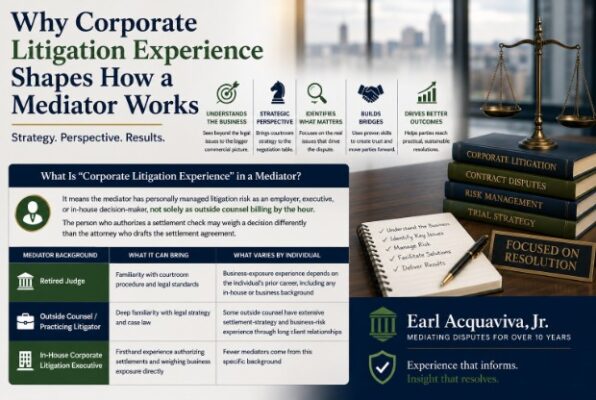
A mediator who has personally directed corporate litigation — not just represented clients as outside counsel — brings a different perspective on settlement authority and cost exposure.
Earl J. Acquaviva, Jr. spent more than three decades as Senior Vice President, General Counsel, and Chief Litigation Officer of Bally Total Fitness Corporation. He personally oversaw litigation strategy for a company operating 400+ locations across 29 states and Canada.
That background is a reasoned argument for what a mediator brings to the table, not a claim about any specific case outcome.
Earl J. Acquaviva, Jr. brings decades of settlement-authority experience to every mediation — review his case study or schedule a consultation to discuss a dispute.
Corporate litigation experience in a mediator context means the mediator has personally managed litigation risk as an employer, executive, or in-house decision-maker, not solely as outside counsel billing by the hour.
That distinction can matter, since the person who authorizes a settlement check may weigh a decision differently than the attorney who drafts the settlement agreement — though individual experience varies widely within any professional background.
Mediators generally arrive at the role from one of a few backgrounds: retired judges, practicing litigators who represented plaintiffs or defendants as outside counsel, or — less commonly — executives who personally carried litigation and settlement authority for an organization.
Each background can bring something different to a mediation table, and many judges and outside counsel bring substantial business-risk and settlement experience of their own.
| Mediator Background | What It Can Bring | What Varies by Individual |
| Retired Judge | Familiarity with courtroom procedure and legal standards | Business-exposure experience depends on the individual’s prior career, including any in-house or business background |
| Outside Counsel / Practicing Litigator | Deep familiarity with legal strategy and case law | Some outside counsel have extensive settlement-strategy and business-risk experience through long client relationships |
| In-House Corporate Litigation Executive | Firsthand experience authorizing settlements and weighing business exposure directly | Fewer mediators come from this specific background |
A mediator who has personally sat in the decision-making seat — weighing settlement costs against litigation risk, business disruption, and reputational exposure — brings that experience to their reading of a negotiation.
As Bally’s Chief Litigation Officer, Acquaviva managed all litigation, claims, adjusters, and outside counsel throughout every phase of dispute resolution and personally attended hearings, mediations, arbitrations, and settlement conferences in multiple jurisdictions.
That role required him to authorize — or decline — settlements as the actual party in interest, the same position most parties find themselves in during mediation today.
Bally Total Fitness operated more than 400 fitness centers across 29 states and Canada, employed over 20,000 people, and served more than 4 million members during Acquaviva’s tenure as Senior Vice President, General Counsel, and Chief Litigation Officer.
Managing litigation exposure at that scale required assessing complex fact patterns quickly and directing resolution strategy across state lines — experience that carries over to multi-jurisdictional mediation today.
In 1990, Acquaviva designed and led Bally’s nationwide Employment Dispute Resolution Procedure, an internal ADR program that voluntarily resolved wrongful termination, discrimination, wage-and-hour, and workplace conflict claims across the company’s national footprint without litigation. Full details of that program are available on his case study page.
| Bally Corporate Litigation Responsibility | Corresponding Mediation Skill |
| Directed litigation, claims, and outside counsel across 29 states and Canada | Assessing multi-jurisdictional exposure quickly in complex disputes |
| Personally authorized settlement decisions as the corporate party | Firsthand familiarity with what settlement authority weighs, alongside legal argument |
| Designed the 1990 Employment Dispute Resolution Procedure | Structuring a resolution-first process rather than an adversarial one |
| Drafted and negotiated lease, vendor, IP, and M&A agreements | Fluency across contract, IP, and commercial dispute types |
An attorney who represents a party in litigation advocates for that party’s position but does not personally bear the consequences of a settlement decision.
A principal participant — the executive who signs off on the number — carries that decision directly, which can shape how they read risk, timing, and negotiation posture, though outside counsel with long-term client relationships may develop similar instincts over time.
His role at Bally required him to make that call repeatedly across personal injury, employment, contract, and multi-jurisdictional class-action matters for more than three decades.
He now applies that decision-maker’s perspective as a neutral mediator, rather than as an advocate for either side.
Earl J. Acquaviva, Jr. mediates business, employment, and injury disputes across Maryland — schedule a mediation to discuss a specific case directly.
Corporate litigation management experience is not limited to one type of case. Acquaviva mediates business and contract disputes, employment and discrimination claims, personal injury and wrongful death matters, and complex multi-jurisdictional class actions across all Maryland Circuit Courts and in private disputes spanning 13 states — MD, VA, MA, PA, CA, AZ, DC, NC, AL, WA, TX, OH, and WI.
He holds Business and Technology mediator approval under Maryland Rule 17-205(b), in addition to his general civil roster approval, and maintains active standing in the Maryland Program for Mediator Excellence and membership in the Association for Conflict Resolution, Maryland Chapter.
Parties evaluating mediators for a business, employment, or complex dispute can reasonably ask what kind of experience a candidate brings — courtroom familiarity, advocacy experience, or firsthand settlement-authority experience.
Each answers a different question about how the mediator will read the negotiation, and no single background fits every dispute; interpersonal skill, subject familiarity, and neutrality matter alongside professional background.
Parties who want a mediator who has personally weighed the litigation costs against the settlement value can review his background directly.
What does “corporate litigation experience” mean for a mediator?
It means the mediator personally managed litigation risk and settlement authority as an executive or in-house decision-maker, not only as outside counsel representing a client. This differs from courtroom experience as a judge or advocacy experience as a practicing litigator representing one side.
What is a “principal participant” in mediation terms?
A principal participant is someone who personally held settlement authority and bore the consequences of litigation decisions, rather than advocating for another party’s interests. This term describes Acquaviva’s role at Bally Total Fitness, since he authorized settlement decisions directly as Chief Litigation Officer.
What was Earl Acquaviva’s role at Bally Total Fitness?
Acquaviva served as Senior Vice President, General Counsel, and Chief Litigation Officer of Bally Total Fitness Corporation for more than three decades, managing litigation, claims, and outside counsel for a company operating 400+ fitness centers across 29 states and Canada.
Does corporate litigation experience apply to employment mediation specifically?
Yes. In 1990, Acquaviva designed Bally’s nationwide Employment Dispute Resolution Procedure, an internal ADR program that voluntarily resolved wrongful termination, discrimination, and wage-and-hour disputes across the company’s national footprint without ever going to litigation, directly informing his employment mediation practice today.
Is a mediator with corporate litigation experience better than a retired judge?
Each background brings different strengths, and fit depends on the dispute. A retired judge brings courtroom and procedural familiarity; some also bring in-house or business experience depending on their prior career. A mediator with corporate litigation experience brings firsthand experience with settlement authority and business exposure. Which fits a specific dispute depends on the parties’ priorities and the type of case.
Does Earl Acquaviva mediate cases outside Maryland?
Yes. In addition to being approved in all Maryland Circuit Courts for civil, business, and technology case types, and an approved Maryland Circuit Court Civil Mediator since 2012, Acquaviva has private mediation experience spanning 13 states nationwide — MD, VA, MA, PA, CA, AZ, DC, NC, AL, WA, TX, OH, and WI.
What is the Bally Total Fitness case study page about?
Acquaviva’s corporate ADR case study page details his work designing and leading Bally’s internal Employment Dispute Resolution Procedure in 1990, as well as his broader litigation-management experience across the company’s national operations spanning more than 400 fitness centers in 29 states and Canada.
Does this experience apply to multi-state or class-action disputes?
Yes. Acquaviva’s role managing Bally’s litigation exposure across 29 states and Canada directly informs how he now applies his complex, multi-jurisdictional class-action mediation experience to the 13 states where he handles private business, employment, and personal injury disputes for clients nationwide.
What professional credentials support Earl Acquaviva’s mediation practice?
Acquaviva is approved in all Maryland Circuit Courts since 2012, holds Business and Technology mediator approval under Rule 17-205(b), and maintains active standing in the Maryland Program for Mediator Excellence and membership in the national Association for Conflict Resolution, Maryland Chapter.
A mediator’s professional background shapes how they read a negotiation. Earl J. Acquaviva, Jr. spent more than three decades personally directing litigation strategy and authorizing settlements as Bally Total Fitness’s Chief Litigation Officer — a “principal participant” perspective distinct from courtroom or advocacy experience alone.
That background now informs his mediation practice across business, employment, personal injury, and multi-jurisdictional disputes throughout Maryland and 13 states nationwide.
Experience authorizing real settlement decisions is different from arguing one side of them — contact Earl Acquaviva to discuss a specific dispute.