
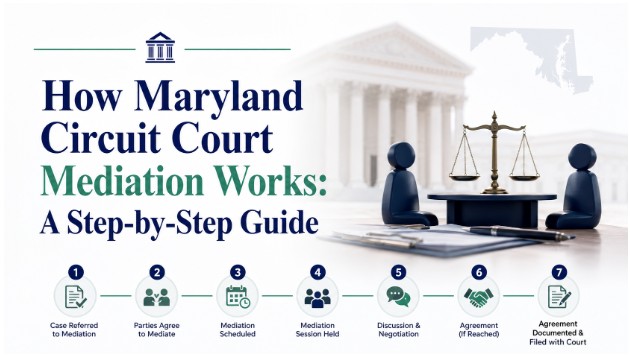
Mediation is a structured negotiation process in which an impartial mediator helps disputing parties reach a voluntary agreement without trial.
Maryland Circuit Courts operate ADR programs under Title 17 of the Maryland Rules, and judges routinely order commercial disputes to mediation before allowing cases to proceed to trial.
The process moves through six stages — from the court’s initial mediation order through agreement drafting and enforcement — and typically concludes within one to three sessions over 30 to 60 days.
Earl Acquaviva, an approved Business and Technology Mediator in all Maryland Circuit Courts and an approved Civil Litigation Mediator since 2012, guides parties through each stage.
A commercial dispute does not have to consume months of litigation — schedule a mediation with Earl Acquaviva to start the resolution process this week.
A business dispute enters Maryland Circuit Court mediation through one of two paths: the court orders mediation after a civil case is filed, or the parties agree to private mediation before or during litigation.
Under Maryland Rule 17-201, a circuit court judge may order parties and their attorneys to participate in mediation at any point during a pending civil case.
The court issues a scheduling order that names the assigned mediator, sets a mediation completion deadline, and identifies the case track.
The mediation deadline varies by county and case complexity:
If a party believes mediation is unnecessary, Maryland Rule 17-202(f) allows filing a Motion for Exemption within 30 days of the assignment date. The court grants the motion only if it determines mediation will not be productive.
Parties may engage a private mediator at any time — before a lawsuit is filed, during pending litigation, or after a judgment to resolve enforcement disputes.
Private mediation operates outside the court’s scheduling framework, giving the parties complete control over timing, mediator selection, and session format.
Acquaviva provides private mediation for commercial disputes that benefit from a mediator with direct subject-matter expertise and more than 30 years of corporate experience.
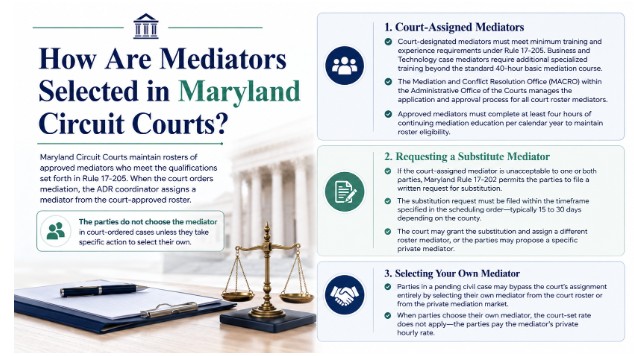
Maryland Circuit Courts maintain rosters of approved mediators who meet the qualifications set forth in Rule 17-205. When the court orders mediation, the ADR coordinator assigns a mediator from the court-approved roster.
The parties do not choose the mediator in court-ordered cases unless they take specific action to select their own.
Court-designated mediators must meet minimum training and experience requirements under Rule 17-205. Business and Technology case mediators require additional specialized training beyond the standard 40-hour basic mediation course.
The Mediation and Conflict Resolution Office (MACRO) within the Administrative Office of the Courts manages the application and approval process for all court roster mediators.
Approved mediators must complete at least four hours of continuing mediation education per calendar year to maintain roster eligibility.
If the court-assigned mediator is unacceptable to one or both parties, Maryland Rule 17-202 permits the parties to file a written request for substitution. The substitution request must be filed within the timeframe specified in the scheduling order — typically 15 to 30 days, depending on the county.
The court may grant the substitution and assign a different roster mediator, or the parties may propose a specific private mediator.
Parties in a pending civil case may bypass the court’s assignment entirely by selecting their own mediator from the court roster or from the private mediation market. When parties choose their own mediator, the court-set rate does not apply — the parties pay the mediator’s private hourly rate.
This option allows business owners to select a mediator whose professional background aligns with the specific type of commercial dispute at issue, which matters in technology disputes, multi-party matters, and cases involving complex multi-jurisdictional issues.
Effective mediation preparation determines whether a session produces a resolution or becomes an unproductive exercise. The mediator, the opposing party, and the court all operate more efficiently when both sides arrive prepared with organized information and realistic expectations.
Parties and their attorneys should complete the following before the first mediation session:
Maryland mediation sessions follow a structured but flexible format that the mediator adapts to the specific dispute. Sessions typically last two to four hours, though complex business disputes may require multiple sessions.
The mediator cannot force either party to accept terms, cannot impose a decision, and does not act as a judge.
Under Maryland Rule 17-103, the mediator’s role is to help identify issues and options, assist the parties in exploring the needs underlying their positions, and — upon request — record points of agreement.
| Session Phase | What Happens | Typical Duration |
| Opening statements | Mediator explains ground rules (confidentiality, voluntary participation, respectful communication). Each party presents their perspective without interruption. | 20–40 minutes |
| Joint discussion | A mediator facilitates direct conversation between the parties to clarify issues, identify areas of agreement, and surface underlying interests. | 30–60 minutes |
| Caucuses (private sessions) | Mediator meets separately with each side to explore settlement options, test proposals, and discuss concerns confidentially. Information shared in caucus stays private unless the party authorizes disclosure. | 30–90 minutes |
| Negotiation and agreement | The mediator helps bridge the remaining gaps by reframing positions, suggesting compromises, and focusing on practical outcomes. If the parties reach an agreement, the terms are documented. | 30–60 minutes |
All mediation communications are confidential under the Maryland Mediation Confidentiality Act (Courts and Judicial Proceedings Article, Title 3, Subtitle 18). Nothing discussed during mediation — including offers, counteroffers, and admissions — can be used in court if the case proceeds to litigation.
Your dispute deserves a mediator who has resolved complex commercial conflicts for more than three decades — contact Earl Acquaviva to discuss your case before the next court deadline.
When parties reach a resolution, the mediator assists in documenting the agreement’s key terms during the session or immediately afterward. The agreement must be specific enough to function as an enforceable contract — naming the parties, listing each obligation, setting payment amounts and deadlines, and specifying performance triggers.
A mediation agreement that holds up under Maryland contract law addresses every material term the parties negotiated:
Both parties sign the final agreement during or immediately after the mediation session. Initialing key pages and signing the final page with full signatures prevents later disputes over which version is binding.
A signed mediation agreement functions as a binding contract under Maryland law. If a party fails to comply, the other party can sue for breach of contract in civil court. Converting the agreement into a court order provides stronger enforcement tools.
| Enforcement Path | How It Works | Enforcement Tools Available |
| Private contract (no court filing) | A signed agreement stands as a binding contract. A breach requires filing a new civil action. | Breach of contract lawsuit, damages |
| Consent order (filed with court) | Parties or their attorneys convert the mediation agreement into a proposed consent order and submit it for the judge’s signature in the existing case. | Contempt proceedings, court sanctions, modification petitions |
| Incorporated into judgment | In court-ordered mediations, the settlement terms can be incorporated into the court’s final order or judgment. | Full court enforcement, contempt powers |
For commercial disputes, converting the mediation agreement into a consent order is the stronger path. A consent order gives the non-breaching party access to contempt proceedings — a faster and more direct enforcement mechanism than filing a new breach-of-contract lawsuit.
Both court-ordered and private mediation follow the same core process — a neutral mediator facilitates negotiation between the parties. The differences are in timing, cost structure, mediator selection, and process control.
Court-ordered mediation operates within the circuit court’s administrative framework. The ADR coordinator assigns the mediator, sets the completion deadline, and applies the court-set fee schedule.
Under Rule 17-208, county administrative judges set maximum hourly rates — published through each county’s ADR program — for court-designated mediators, subject to approval by the Chief Judge of the Court of Appeals.
Current court-ordered mediation rates by county (as of July 2026):
County ADR programs publish approved rate schedules on their respective circuit court websites.
Private mediation allows the parties to select their own mediator, schedule sessions around business operations, and design the process — including whether to use caucuses, how many sessions to hold, and whether preliminary information exchange occurs before the first session.
Private mediator rates typically range from $200 to $500 per hour, and the mediator’s rate reflects experience, specialization, and the dispute’s complexity.
Acquaviva has conducted successful multi-state mediations across 13 jurisdictions — Maryland, Virginia, Massachusetts, Pennsylvania, California, Arizona, the District of Columbia, North Carolina, Alabama, Washington, Texas, Ohio, and Wisconsin. That multi-jurisdictional experience matters for Maryland businesses whose disputes involve parties, contracts, or employment relationships in other states.
Stop waiting for the court’s calendar to dictate your resolution timeline — schedule a mediation with Acquaviva Mediation and resolve your dispute on your terms.
How long does Maryland Circuit Court mediation take?
Most Maryland business mediations are completed within one to three sessions over 30 to 60 days. Individual sessions last two to four hours. Court-ordered mediation must conclude by the scheduling order deadline — 180 days in Baltimore County and one week before the pretrial hearing in Montgomery County.
How much does court-ordered mediation cost in Maryland?
Maryland court-ordered mediation rates range from $200 to $300 per hour, depending on county and case track. Baltimore County charges $250-$300 per hour as of March 2026, and Montgomery County charges $200 per hour for standard cases. Costs are split pro rata between parties.
Can I choose my own mediator in the Maryland Circuit Court?
Maryland Rule 17-202 allows parties to select their own mediator rather than accept the court-assigned neutral. Parties who choose their own mediator pay the private hourly rate rather than the court-set rate and must file a timely written request with the court.
Is mediation confidential in Maryland?
The Maryland Mediation Confidentiality Act (Courts and Judicial Proceedings Article, Title 3, Subtitle 18) protects all mediation communications from disclosure. Nothing said, written, or presented during mediation can be used in court. Exceptions exist for child abuse reports, imminent threats, and fraud or duress.
What happens if we cannot reach an agreement in mediation?
The case returns to the litigation track with all rights preserved. Nothing discussed during mediation is admissible in court under the Maryland Mediation Confidentiality Act. Even unsuccessful mediations often narrow the disputed issues, which reduces the scope and cost of any subsequent trial.
Is a Maryland mediation agreement legally binding?
A signed mediation agreement is enforceable as a binding contract under Maryland law, and either party can sue for breach if the other fails to perform. Converting the agreement into a consent order filed with the court provides stronger enforcement tools, including contempt proceedings.
Do I need an attorney for mediation in Maryland?
Maryland mediation does not legally require attorney representation, but having an attorney present protects legal rights, ensures the agreement’s enforceability, and prevents the use of unfavorable terms. Attorneys can participate in sessions, advise during caucuses, and review the final agreement before signing.
What types of disputes does the Maryland Circuit Court mediate?
Maryland Circuit Courts mediate contract disputes, business disagreements, employment conflicts, personal injury claims, construction disputes, real estate matters, and commercial lease disagreements. Maryland Rule 9-205 also authorizes court-ordered mediation in family law cases involving property division and other contested domestic matters.
Can mediation happen before a lawsuit is filed in Maryland?
Private mediation can occur at any time, including before a lawsuit is filed in Maryland Circuit Court. Pre-litigation mediation often resolves disputes faster and at lower cost because neither party has incurred discovery expenses, deposition costs, or filing fees, and business relationships sustain less damage.
What qualifications must a Maryland court-approved mediator have?
Maryland Rule 17-205 requires court-designated mediators to complete a 40-hour basic mediation training program, demonstrate mediation experience, and complete four hours of continuing education annually. Business and Technology case mediators must complete additional specialized training beyond the standard curriculum to qualify for the court roster.