
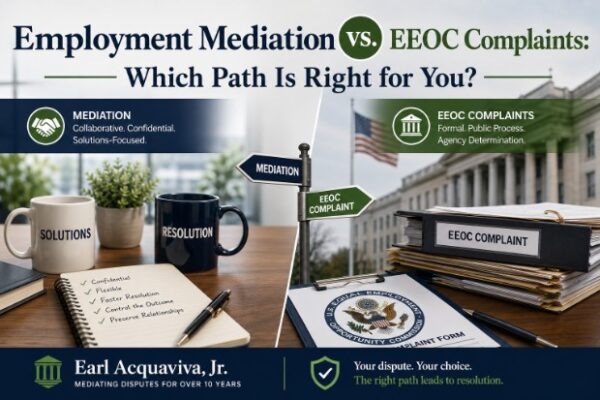
Employees facing workplace discrimination in Maryland have two distinct paths: filing a formal charge with the EEOC or the Maryland Commission on Civil Rights, or pursuing private mediation directly with the employer.
Published estimates put EEOC investigations at roughly 6 to 18 months, while private mediation with an independent mediator often resolves in 1 to 3 sessions.
The two paths are not always mutually exclusive — private mediation can run alongside a preserved agency charge, or resolve a dispute an employee never intends to litigate.
Timeline is a real factor for many employees weighing these paths — private employment mediation with Earl J. Acquaviva, Jr. can often move faster than the agency process, without waiting on an investigator’s queue.
The EEOC complaint process is a formal administrative procedure in which an employee files a Charge of Discrimination against an employer, triggering federal agency review. Filing is free, and the employer receives formal notice of the charge shortly after the EEOC accepts it.
Maryland employees generally have 300 days from the date of the discriminatory act to file, because Maryland’s work-sharing agreement between the EEOC and the Maryland Commission on Civil Rights extends the federal base 180-day deadline.
The exact deadline and process can differ by claim type and by which agency ultimately handles it, so this figure should be treated as general guidance rather than a calculation for a specific case.
EEOC’s own guidance states that a charging party must generally allow the agency 180 days to act on a charge before requesting an early resolution.
| Agency | Filing Deadline | Governing Law |
| EEOC (federal) | 300 days in Maryland, under the MCCR work-share agreement | Title VII, ADA, ADEA |
| Maryland Commission on Civil Rights | 300 days from the discriminatory act | Maryland Fair Employment Practices Act |
| Right to Sue (after Notice issued, Title VII/ADA) | 90 days from receipt of the Notice | Title VII, ADA |
Private employment mediation is a voluntary process in which an independent mediator helps an employee and employer negotiate a resolution outside the EEOC or MCCR process entirely.
Unlike an agency charge, private mediation requires no filing, no formal notice period, and no waiting for an agency to act.
Earl J. Acquaviva, Jr. designed and led Bally Total Fitness Corporation’s nationwide Employment Dispute Resolution Procedure in 1990, an internal ADR program that voluntarily resolved wrongful termination, discrimination, wage-and-hour, and workplace conflict claims across the company’s national footprint without litigation.
He now applies that same structured approach to private employment and discrimination mediation for Maryland employers and employees, working from his Kingsville office or by Zoom.
Published estimates from employment law sources place EEOC investigations at roughly 6 to 18 months from charge filing to a determination, depending on case complexity and the local office’s caseload; EEOC does not publish a single official average processing time, so this range reflects the pattern across multiple third-party employment-law guides rather than one agency-stated figure.
The EEOC also offers its own free, voluntary mediation program early in the process; when both parties agree to participate, the EEOC’s published program information states an average processing time of 84 days, with most sessions completed in a single meeting lasting one to five hours.
Private mediation outside the agency process often resolves in 1 to 3 sessions — consistent with Acquaviva’s typical private mediation practice — and is scheduled directly between the parties, without waiting on an investigator’s caseload.
Parties who want the fastest possible resolution and are willing to negotiate directly rather than build an investigative record often find private mediation faster than either the EEOC’s investigation track or its internal mediation program.
Filing an EEOC or MCCR charge costs nothing, and the EEOC’s own mediation program is free to both parties. These costs remain fixed regardless of how long an investigation takes.
Private mediation carries an hourly mediator fee, often split between the parties, that private employment attorneys typically weigh against the alternative cost of prolonged litigation, discovery, and attorney fees if a charge proceeds to a lawsuit.
Parties weighing cost should compare a mediator’s hourly rate against the cost of continued litigation if the dispute is not resolved early.
EEOC mediation sessions are confidential under the agency’s own program rules — sessions are not recorded or transcribed, and information disclosed during an unsuccessful mediation cannot be used in a later investigation.
An EEOC charge itself, however, is not anonymous: the employer is formally notified, and the charge becomes part of the agency’s case file. It can surface in later litigation if the case proceeds to a lawsuit.
Private mediation is generally kept confidential under a written agreement between the parties, with no charge filed and no agency case file created.
That confidentiality typically depends on the terms the parties agree to, and it can have exceptions — for example, a signed settlement agreement may need to be disclosed later if a party seeks to enforce it in court.
Parties who want to resolve a dispute without a filed agency record generally find private mediation offers a different, more self-directed form of confidentiality than the EEOC’s program, rather than a guarantee.
Private mediation does not replace filing an administrative charge for an employee who wants to preserve the right to sue — but the specific requirement differs by which law applies, and this is exactly where a Maryland employment attorney’s advice matters most.
Under federal law: an employee generally must file an EEOC charge and receive a Notice of Right to Sue before filing suit under Title VII or the ADA.
The ADEA works differently — under 29 U.S.C. § 626, an employee may file an age-discrimination lawsuit as soon as 60 days after filing an EEOC charge, without waiting for a formal Right to Sue notice, so long as the charge itself was filed within the 300-day deadline.
Under Maryland state law: Maryland State Government § 20-1013 allows a complainant to bring a civil action in Maryland circuit court once they have filed a timely administrative charge and at least 180 days have elapsed since filing — filing the civil action automatically ends the pending MCCR proceeding.
The civil action must generally be filed within 2 years of the discriminatory act, or 3 years for harassment claims.
For the two paths discussed in this article, the general starting point is the same: a timely administrative charge.
An employee who settles privately without ever filing that charge gives up the ability to use either path later if the private settlement falls through.
Employees who want to preserve their options can file a charge to protect the deadline and pursue private mediation in parallel, since other forums for resolution may generally be pursued concurrently with an MCCR charge.
An employee who does not intend to litigate, or whose dispute falls outside what the EEOC and MCCR cover, may reasonably choose private mediation alone.
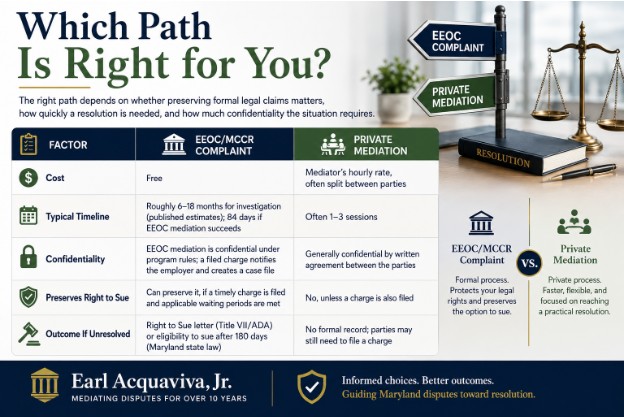
The right path depends on whether preserving formal legal claims matters, how quickly a resolution is needed, and how much confidentiality the situation requires.
| Factor | EEOC/MCCR Complaint | Private Mediation |
| Cost | Free | Mediator’s hourly rate, often split between parties |
| Typical Timeline | Roughly 6-18 months for investigation (published estimates); 84 days if EEOC mediation succeeds | Often 1-3 sessions |
| Confidentiality | EEOC mediation is confidential under program rules; a filed charge notifies the employer and creates a case file | Generally confidential by written agreement between the parties |
| Preserves Right to Sue | Can preserve it if a timely charge is filed and applicable waiting periods are met | No, unless a charge is also filed |
| Outcome If Unresolved | Right to Sue letter (Title VII/ADA) or eligibility to sue after 180 days (Maryland state law) | No formal record; parties may still need to file a charge |
Employees uncertain which path fits their situation can discuss both options directly, particularly before a filing deadline approaches.
How long does an EEOC complaint take in Maryland?
Published estimates place EEOC investigations at roughly 6 to 18 months from charge filing to determination, depending on case complexity and caseload; EEOC does not publish one official average. The EEOC’s own voluntary mediation program, offered early in the process, averages 84 days per EEOC’s published program data.
How long does private employment mediation take?
Private employment mediation with an independent mediator often resolves in 1 to 3 sessions, scheduled directly between the parties, consistent with Acquaviva’s typical practice. Unlike an EEOC charge, private mediation requires no filing or agency caseload wait and can often be scheduled quickly.
Does private mediation cost money in Maryland?
Private mediation involves an hourly fee for the mediator, often split between the parties. Filing an EEOC or Maryland Commission on Civil Rights charge is free, and the EEOC’s own internal mediation program is also free to both the employee and the employer.
What is the deadline to file an employment discrimination charge in Maryland?
Maryland employees generally have 300 days from the discriminatory act to file with the EEOC or MCCR, under the agencies’ work-sharing agreement. This is general guidance; exceptions and different deadlines can apply depending on the claim, so confirming the specific deadline with an attorney is advisable.
Does mediation replace the need to file an EEOC charge?
No. Private mediation alone does not preserve the right to sue under Title VII, the ADA, the ADEA, or Maryland’s Fair Employment Practices Act. Each of those paths requires a timely administrative charge first — the specific waiting period and notice requirement differ by statute.
Is EEOC mediation the same as private mediation?
No. EEOC mediation is a free, voluntary program offered by the agency itself early in the charge process, and it requires both parties to agree to participate. Private mediation uses an independent mediator selected directly by the parties, entirely outside the EEOC process, with no charge filed.
Is private mediation confidential in employment disputes?
Private mediation is generally kept confidential under a written agreement between the parties, with no charge filed and no agency case file created. EEOC mediation is also confidential under the agency’s program rules, though filing an EEOC charge itself formally notifies the employer and creates an agency record.
Can I pursue private mediation and file an EEOC charge at the same time?
Yes. Filing a charge preserves the deadline, and other forums for resolution, including private mediation, may generally be pursued concurrently with an MCCR or EEOC charge, without extending the original filing deadline.
What happens if I miss the 300-day filing deadline in Maryland?
Missing the 300-day deadline generally forecloses the ability to pursue that specific discrimination claim through the EEOC or MCCR administrative process, and — since both the federal Right to Sue path and Maryland’s § 20-1013 civil-action path require a timely administrative charge first — it generally forecloses those two paths as well. An employment attorney can advise whether any other exception or legal theory might still apply.
Which path is faster, EEOC mediation or private mediation?
Private mediation, often resolved in 1 to 3 sessions scheduled directly between the parties, is generally faster than the EEOC’s own mediation program, which averages 84 days per EEOC’s published data and depends on both the agency’s scheduling and both parties agreeing to participate.
An EEOC or MCCR charge can preserve an employee’s path to a lawsuit when filed within the applicable deadline and waiting period, and it costs nothing — but, by published estimates, investigation timelines run longer than most private processes.
Private mediation often resolves in fewer sessions and offers a more self-directed form of confidentiality, but does not by itself preserve federal or Maryland discrimination claims.
The two paths can run in parallel: filing to preserve the deadline while pursuing private mediation to resolve the dispute more quickly. This article is general information, not legal advice for a specific case.
Deadlines in employment discrimination cases move fast — contact Earl Acquaviva to discuss whether private mediation fits a specific timeline and situation.