

Employment dispute mediation is a structured, confidential process in which a neutral mediator helps an employer and an employee negotiate a voluntary resolution without a trial or an agency investigation.
Baltimore-area employees and employers can pursue mediation through two paths — the EEOC’s free mediation program or private mediation with a mediator who has direct employment law experience.
Earl Acquaviva, an approved Business and Technology Mediator in all Maryland Circuit Courts and an approved Civil Litigation Mediator since 2012, designed the Bally Employment Dispute Resolution Procedure, which resolved employment disputes in 29 states
An unresolved employment dispute costs both sides in legal fees, lost productivity, and damaged relationships — schedule a mediation with Acquaviva Mediation to start the resolution process this week.
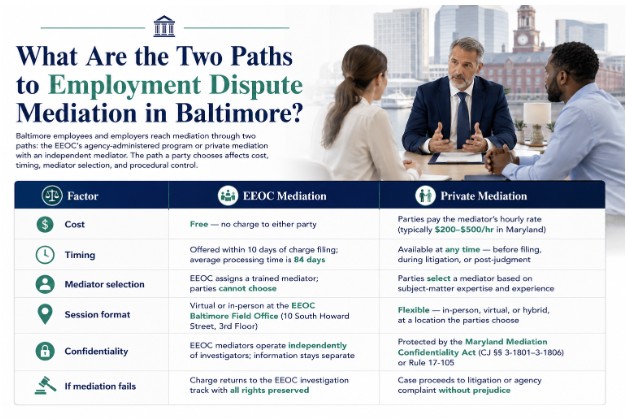
Baltimore employees and employers reach mediation through two paths: the EEOC’s agency-administered program or private mediation with an independent mediator. The path a party chooses affects cost, timing, mediator selection, and procedural control.
| Factor | EEOC Mediation | Private Mediation |
| Cost | Free — no charge to either party | Parties pay the mediator’s hourly rate (typically $200–$500/hr in Maryland) |
| Timing | Offered within 10 days of charge filing; average processing time is 84 days | Available at any time — before filing, during litigation, or post-judgment |
| Mediator selection | EEOC assigns a trained mediator; parties cannot choose | Parties select a mediator based on subject-matter expertise and experience |
| Session format | Virtual or in-person at the EEOC Baltimore Field Office (10 South Howard Street, 3rd Floor) | Flexible — in-person, virtual, or hybrid, at a location the parties choose |
| Confidentiality | EEOC mediators operate independently of investigators; information stays separate | Protected by the Maryland Mediation Confidentiality Act (CJ §§ 3-1801–3-1806) or Rule 17-105 |
| If mediation fails | Charge returns to the EEOC investigation track with all rights preserved | Case proceeds to litigation or agency complaint without prejudice |
EEOC mediation works well for straightforward discrimination charges where both sides want early, no-cost resolution. Private mediation gives employers and employees more control over the process — including the ability to select a mediator whose professional background includes direct employment law experience in the specific type of dispute at issue.
The EEOC offers mediation as a voluntary alternative to its standard investigation process. The EEOC Baltimore Field Office administers mediation for employment discrimination charges filed within its geographic jurisdiction, which covers Maryland and parts of Virginia.
The EEOC mediation process follows a defined sequence:
The EEOC’s mediation program resolved more than 71% of private-sector mediations in fiscal year 2024, producing $243.2 million in benefits for charging parties across 8,543 resolved cases, according to the EEOC’s FY 2024 Annual Performance Report.
Employer and employee satisfaction rates with the program remain above 96%.
Either party can bring an attorney to the mediation session. The mediator may ask attorneys to advise their clients rather than speak on their behalf, so the parties themselves can express their perspectives directly.
The Maryland Fair Employment Practices Act (FEPA), codified at State Government Article, §§ 20-601 through 20-1202, prohibits employment discrimination based on race, color, religion, sex, age, national origin, marital status, sexual orientation, gender identity, disability, and genetic information.
FEPA applies to Maryland employers with 15 or more employees for discrimination claims and to employers with one or more employees for harassment claims.
The Maryland Commission on Civil Rights (MCCR) enforces FEPA and processes employment discrimination complaints through a defined administrative procedure:
Maryland’s FEPA provides broader protections than federal Title VII in two key categories — including explicit protections for sexual orientation and gender identity and coverage of harassment claims against employers with even a single employee.
Employees who exhaust administrative remedies through the MCCR or EEOC may then pursue civil litigation in Maryland Circuit Court.
The distinction matters for mediation: an employee who files a charge with the EEOC gains access to the EEOC’s free mediation program.
An employee who files with the MCCR may pursue private mediation at any point during the administrative process. In either case, mediation does not waive any right to continue with investigation or litigation if the dispute remains unresolved.
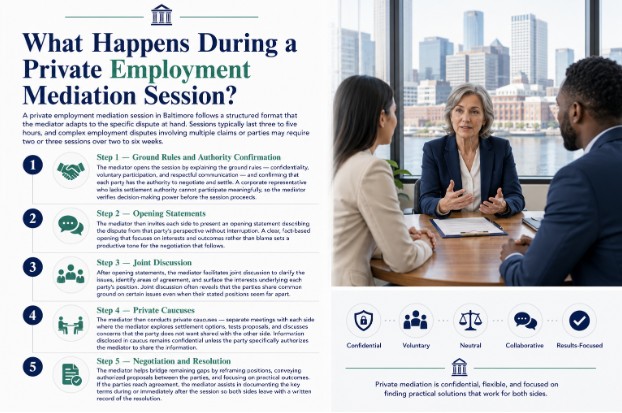
A private employment mediation session in Baltimore follows a structured format that the mediator adapts to the specific dispute at hand. Sessions typically last three to five hours, and complex employment disputes involving multiple claims or parties may require two or three sessions over two to six weeks.
The mediator opens the session by explaining the ground rules — confidentiality, voluntary participation, and respectful communication — and confirming that each party has the authority to negotiate and settle.
A corporate representative who lacks settlement authority cannot participate meaningfully, so the mediator verifies decision-making power before the session proceeds.
The mediator then invites each side to present an opening statement describing the dispute from that party’s perspective without interruption. A clear, fact-based opening that focuses on interests and outcomes rather than blame sets a productive tone for the negotiation that follows.
After opening statements, the mediator facilitates a joint discussion to clarify the issues, identify areas of agreement, and surface the interests underlying each party’s position. Joint discussion often reveals that the parties share common ground on certain issues even when their stated positions seem far apart.
The mediator then conducts private caucuses — separate meetings with each side where the mediator explores settlement options, tests proposals, and discusses concerns that the party does not want shared with the other side. Information disclosed in caucus remains confidential unless the party specifically authorizes the mediator to share the information.
The mediator helps bridge remaining gaps by reframing positions, conveying authorized proposals between the parties, and focusing on practical outcomes. If the parties reach an agreement, the mediator assists in documenting the key terms during or immediately after the session so both sides leave with a written record of the resolution.
Acquaviva’s approach to employment mediation draws on 40 years of employment law practice, including his role as Chief Equal Opportunity Officer and Chief Litigation Counsel at Bally Total Fitness Corporation.
Your employment dispute does not have to become a year-long investigation or a six-figure lawsuit — contact Earl Acquaviva to discuss how mediation can resolve the matter efficiently.
Preparation determines whether a mediation session produces resolution or becomes an unproductive exercise. Both employees and employers should invest time before the session to organize their information, clarify their objectives, and understand the process.
Employees should take the following steps before arriving at the mediation session:
Employers should ensure that the right representative attends the session — someone with full settlement authority who understands the facts, the applicable policies, and the financial exposure. A corporate representative without authority to approve settlement terms wastes the session and frustrates the other party.
Employers should also prepare by reviewing the employee’s personnel file, consulting with legal counsel about exposure under Maryland and federal employment law, and identifying the true cost of continued litigation — including attorney fees, management time, discovery costs, and reputational risk.
Comparing those costs against a reasonable settlement range often reveals that early mediation serves the company’s interests better than prolonged adversarial proceedings.
Confidentiality is the foundation that allows employees and employers to speak openly about sensitive workplace issues — including discrimination, harassment, and retaliation — without fear that their statements will appear in court filings or agency records. Maryland protects mediation confidentiality through two legal frameworks that apply depending on how the mediation is initiated.
| Framework | When It Applies | What It Protects | Key Citation |
| Maryland Rule 17-105 | Court-ordered mediation under Title 17 of the Maryland Rules | All communications made during court-referred mediation sessions; the mediator cannot be called to testify | Title 17, Maryland Rules |
| Maryland Mediation Confidentiality Act | Private mediation not governed by Title 17 — including pre-litigation and voluntary mediation | All mediation communications (speech, writing, and conduct made as part of the mediation); the mediator must state in writing adherence to the Maryland Standards of Conduct for Mediators to invoke the Act | CJ §§ 3-1801 through 3-1806 |
Both frameworks prohibit the use of mediation communications in any judicial, administrative, or other proceeding. Neither the mediator nor the parties may disclose what occurred during the session.
Exceptions under both frameworks are narrow — limited to mandatory reports of child abuse, threats of imminent harm, and allegations of fraud or duress used to obtain the mediation agreement.
A mediation agreement that resolves an employment dispute functions as a legally binding contract under Maryland law. The agreement must address every material term the parties negotiated — naming the parties, specifying the relief, setting deadlines, and defining what happens if either side fails to perform.
Employment mediation agreements typically include the following terms:
For EEOC-mediated settlements, the signed agreement ends the EEOC’s involvement and closes the charge.
The agreement is enforceable in federal court. For private mediation settlements in pending litigation, the parties may convert the agreement into a consent order, which is filed with the court for stronger enforcement tools, including contempt proceedings.
An employment dispute that has consumed months of investigation and thousands of dollars in legal fees can reach a resolution in a single mediation session — schedule a mediation with Acquaviva Mediation to take control of the outcome.
How long does employment mediation take in Baltimore?
Most Baltimore employment mediations resolve within one to three sessions, each lasting three to five hours. EEOC mediation averages 84 days from initial offer to final resolution. Private mediation operates on the parties’ own schedule and can begin within days of contacting the mediator.
How much does employment mediation cost in Maryland?
EEOC mediation is free to both parties. Private mediation costs reflect the mediator’s hourly rate, typically $200 to $500 per hour in Maryland, with costs split between the parties. Private mediation remains a fraction of the litigation expenses both sides would otherwise incur.
Can my employer force me to attend employment mediation?
Maryland courts may order mediation under Title 17 of the Maryland Rules, requiring attendance but not agreement. EEOC mediation is voluntary — neither party can be compelled to participate. Private mediation is also voluntary unless a contractual ADR clause requires mediation before filing suit.
What types of employment disputes can be mediated in Baltimore?
Mediation can resolve discrimination claims, harassment complaints, wrongful termination disputes, retaliation allegations, wage and hour disagreements, non-compete disputes, Family and Medical Leave Act violations, severance negotiations, and accommodation or leave disputes. The EEOC mediates charges filed under Title VII, the ADA, the ADEA, and the Equal Pay Act.
Is employment mediation confidential in Maryland?
Maryland law protects the confidentiality of employment mediation through two frameworks. Court-ordered mediations are governed by Maryland Rule 17-105, and private mediations are governed by the Maryland Mediation Confidentiality Act (CJ §§ 3-1801 through 3-1806). Both prohibit the use of mediation communications in any subsequent proceeding.
What happens if mediation does not resolve my employment dispute?
The case returns to its prior track — EEOC investigation, MCCR complaint processing, or civil litigation — with all rights preserved. The mediator shares no information with the EEOC investigator or the court. Unsuccessful mediations often narrow the issues in dispute, reducing the cost and scope of subsequent proceedings.
Do I need an attorney for employment mediation?
Neither EEOC nor private mediation requires attorney representation, but having an attorney protects legal rights, ensures the agreement’s enforceability, and prevents an employee from accepting inadequate terms. Attorneys can advise during caucuses and review the final agreement before it is signed.
What is the deadline to file an employment discrimination complaint in Maryland?
Employees must file with the Maryland Commission on Civil Rights within 300 days of the alleged discriminatory act for discrimination and retaliation claims. Harassment claims carry a two-year filing deadline. EEOC charges generally must be filed within 300 days in states with a fair employment practices agency, such as the MCCR.
Can I mediate an employment dispute before filing a formal complaint?
Private mediation can occur at any time, including before filing an EEOC charge or MCCR complaint. Pre-complaint mediation allows both parties to resolve the dispute without creating a public agency record, thereby often preserving the employment relationship and avoiding reputational exposure for both sides.
What qualifications should an employment mediator have?
An effective employment mediator should hold Maryland court-approved mediator status, have direct experience in employment law and workplace dispute resolution, and understand both employee rights and employer obligations under Maryland and federal law. Specialized experience — such as managing corporate ADR programs — provides practical insight that generalist mediators lack.