
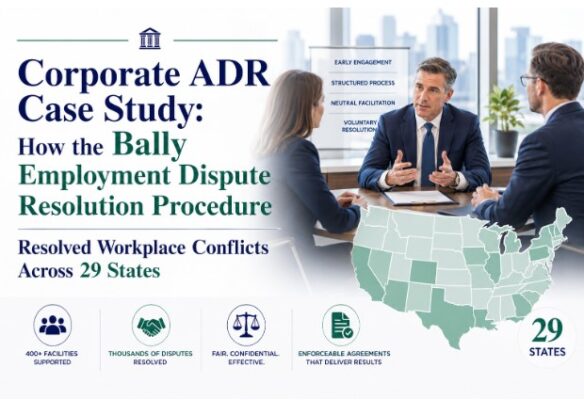
Earl Acquaviva designed and administered the Bally Employment Dispute Resolution Procedure in 1990 — a nationwide ADR program that resolved virtually all employment disputes across more than 400 fitness centers, 20,000 employees, and 29 states.
The program replaced costly, adversarial litigation with structured mediation, giving both employees and management a faster path to resolution while protecting the company from the financial and operational damage of protracted legal proceedings.
Acquaviva now applies that same corporate-side perspective as an approved Business and Technology Mediator in all Maryland Circuit Courts.
Employment disputes drain management time, legal budgets, and workforce morale — schedule a mediation with Acquaviva Mediation to resolve the dispute before the costs compound.
Bally Total Fitness Corporation was the largest commercial operator of fitness centers in North America during the 1990s and 2000s. The company operated more than 400 facilities in 29 states and Canada, employed over 20,000 workers, and served 4 million members — creating one of the most complex multi-state employment compliance environments in the fitness industry.
Every state in which Bally operated imposed its own employment discrimination statutes, filing deadlines, and administrative agencies. California’s Fair Employment and Housing Act operated under different procedural rules than New York’s Human Rights Law.
Maryland’s Fair Employment Practices Act (State Government Article, §§ 20-601 through 20-1202) required compliance with the Maryland Commission on Civil Rights, while federal Title VII, the Americans with Disabilities Act, and the Age Discrimination in Employment Act applied nationwide across all 29 states simultaneously.
The result was a steady volume of employment disputes — discrimination complaints, wrongful termination claims, harassment allegations, wage disputes, and accommodation requests — filed across dozens of jurisdictions, each with different rules, agencies, and litigation calendars.
Each dispute consumed outside counsel fees, management time for depositions and hearings, and operational disruption at the facility level.
Bally needed a system that could resolve employment disputes efficiently across every jurisdiction without requiring individual litigation in each state.
Earl Acquaviva served as Senior Vice President, General Counsel, Secretary, Civil Rights Director, Chief Equal Opportunity Officer, and Human Resources Executive at Bally Total Fitness — a combination of legal, compliance, and HR authority that gave Acquaviva direct control over the company’s entire dispute resolution infrastructure.
In 1990, Acquaviva designed, implemented, and administered the Bally Employment Dispute Resolution Procedure — a structured, nationwide ADR program that provided employees and management with a voluntary path to resolve workplace disputes without litigation. The program followed a defined action sequence:
The Bally Employment Dispute Resolution Procedure resolved virtually all future employment disputes across the organization after its implementation in 1990.
The program operated throughout Acquaviva’s more than 30-year tenure at Bally Total Fitness, spanning more than 400 facilities, 20,000 employees, and 29 states.
The program’s effectiveness came from its design. Employees trusted the process because the mediation was genuinely neutral — not a management tool for suppressing complaints. Management supported the program because resolution through mediation cost a fraction of what litigation consumed in outside counsel fees, management time, and operational disruption.
The voluntary nature of the process meant that agreements were held, because both sides had negotiated terms they could accept.
Bally’s experience parallels broader data on corporate ADR effectiveness. The EEOC’s FY 2024 Annual Performance Report documented a 71% resolution rate across 8,543 private-sector mediations, producing $243.2 million in benefits for charging parties.
The Bally program operated at an even higher resolution rate — handling disputes before they reached the EEOC filing stage, thereby eliminating the costs and delays of formal agency proceedings entirely.
The difference between choosing a mediator who has studied ADR and choosing a mediator who has built and operated a corporate-wide ADR program is the difference between theory and practice — contact Earl Acquaviva to bring that experience to your dispute.
A mediator who has spent decades on the corporate side of employment disputes understands how employers make decisions — what triggers settlement authority, what internal approvals are required, how litigation reserves are set, and what non-monetary terms a company can realistically offer.
Corporate representatives at mediation do not have unlimited authority. A mediator who has served as General Counsel and Chief Litigation Officer knows that the corporate representative must often seek approval from risk management, human resources, and executive leadership before agreeing to settlement terms.
Acquaviva understands how to structure proposals that corporate decision-makers can approve — rather than proposals that sound reasonable in the mediation room but will be rejected by the approval chain.
Most mediators approach employment disputes from one professional background — either plaintiff-side employment law or defense-side corporate practice. Acquaviva’s career combined both perspectives in a single role: as Chief Equal Opportunity Officer, Acquaviva managed the company’s civil rights compliance and responded to employee complaints.
As Chief Litigation Officer, Acquaviva supervised the defense of claims that could not be resolved internally. That dual perspective allows Acquaviva to identify the real interests on both sides of employment disputes — not just the stated positions.
Every mediation agreement Acquaviva mediates reflects the practical constraints that govern corporate compliance — including payment authorization timelines, HR documentation requirements, and the enforceability standards that business and contract disputes demand.
A mediation agreement that falls apart after signing wastes everyone’s time and money, and Acquaviva’s experience guiding parties to durable agreements at corporate scale means the terms hold.
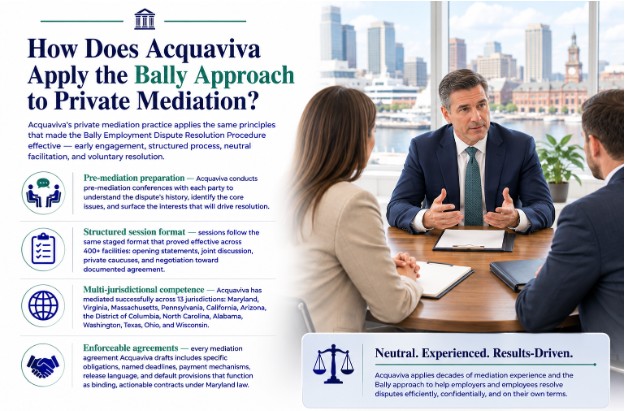
Acquaviva’s private mediation practice applies the same principles that made the Bally Employment Dispute Resolution Procedure effective — early engagement, structured process, neutral facilitation, and voluntary resolution.
Acquaviva has mediated personal injury and wrongful death claims, commercial disputes, and complex multi-jurisdictional matters, in addition to employment disputes — but the Bally corporate ADR experience remains the foundation that distinguishes Acquaviva’s practice from that of every other mediator in Maryland.
Your dispute deserves a mediator who has resolved thousands of employment conflicts from the inside — schedule a mediation with Acquaviva Mediation and bring that experience to your case.
What was the Bally Employment Dispute Resolution Procedure?
The Bally Employment Dispute Resolution Procedure was a nationwide ADR program that Earl Acquaviva designed and implemented in 1990 at Bally Total Fitness Corporation. The program provided structured mediation for employment disputes across more than 400 facilities in 29 states and resolved virtually all disputes mediated.
How many employees did the Bally ADR program cover?
The Bally ADR program covered more than 20,000 employees across 400 fitness centers in 29 states and Canada. Bally Total Fitness was the largest commercial fitness center operator in North America during the program’s operation, serving more than 4 million members.
How long did Acquaviva work at Bally Total Fitness?
Acquaviva served at Bally Total Fitness for more than 30 years as Senior Vice President, General Counsel, Secretary, Civil Rights Director, Chief Equal Opportunity Officer, and Human Resources Executive. Acquaviva has been licensed to practice law in Maryland since 1983.
Why does experience in corporate employment law matter for a mediator?
A mediator with corporate employment law experience understands how employers evaluate litigation risk, authorize settlements, and structure compliance responses. That perspective allows the mediator to craft proposals that corporate decision-makers can approve, rather than proposals that are rejected by internal approval processes.
What types of disputes does Acquaviva mediate?
Acquaviva mediates employment and discrimination disputes, business and contract disputes, personal injury and wrongful death claims, and complex multi-jurisdictional matters. Acquaviva has successfully mediated across 13 jurisdictions, including Maryland, Virginia, California, Texas, and the District of Columbia.
Is Acquaviva a court-approved mediator?
Acquaviva is an approved Business and Technology Mediator in all Maryland Circuit Courts and has been an approved Civil Litigation Mediator in Maryland Circuit Courts since 2012. Acquaviva also conducts private mediations for complex commercial and employment disputes nationwide outside the court’s administrative framework.
How does the Bally ADR approach differ from EEOC mediation?
The Bally program resolved disputes before employees filed formal EEOC charges, eliminating the cost and delay of agency proceedings entirely. EEOC mediation occurs after a charge is filed and is administered by the agency. Private mediation with Acquaviva offers the same pre-litigation resolution path the Bally program demonstrated at scale.
What is Acquaviva’s hourly rate for private mediation?
Acquaviva’s private mediation rate is $500 per hour. Court-ordered mediation rates in Maryland range from $200 to $300 per hour depending on the county and case track. Private mediation rates reflect the mediator’s experience, specialization, and the complexity of the dispute.
Can Acquaviva mediate employment disputes outside Maryland?
Acquaviva conducts private mediations for employment disputes beyond Maryland in 12 additional jurisdictions — Virginia, Massachusetts, Pennsylvania, California, Arizona, the District of Columbia, North Carolina, Alabama, Washington, Texas, Ohio, and Wisconsin — totaling 13 states and jurisdictions.
How do I schedule a mediation with Acquaviva?
Parties can schedule a mediation by contacting Acquaviva Mediation directly or through the online scheduling form at acquavivamediation.com. Acquaviva conducts mediations in person, virtually, or in a hybrid format based on the parties’ preferences and the dispute’s requirements.