
Mediation resolves Maryland business disputes in weeks instead of months, costs 50–80% less than litigation, and keeps sensitive commercial information out of public court records.
Earl Acquaviva, an approved Business and Technology Mediator in all Maryland Circuit Courts with more than 30 years of corporate dispute resolution experience, has conducted successful complex multi-state mediation sessions for business and contract disputes across 13 jurisdictions.
Acquaviva Mediation, based in Maryland, provides private mediation services for businesses seeking faster, more cost-effective alternatives to commercial litigation.
Protect your revenue and your business relationships — schedule a mediation consultation with Earl Acquaviva before litigation costs escalate.
Business mediation in Maryland costs 50–80% less than commercial litigation. The cost gap widens as disputes increase in complexity, making mediation the more predictable financial commitment for business owners at every scale.
Maryland Circuit Courts set court-ordered mediation rates under Maryland Rule 17-208. Montgomery County Circuit Court charges $200 per hour for Track 2 and 3 civil cases and $250 per hour for Tracks 4 through 6.
Baltimore County updated its civil mediation rates in March 2026 to $250 per hour for non-domestic civil cases and $300 per hour for Track 3 Civil Complex cases. Baltimore City Circuit Court maintains a court-ordered rate of $200 per hour.
Private mediation with an experienced neutral typically costs $200–$500 per hour, with most business mediations completing in 4 to 12 hours of total session time. The entire mediation process — from intake through resolution — often stays below $10,000 for both parties combined.
Maryland business litigation tells a different financial story. The average hourly rate for a civil litigation attorney in Maryland reached $354 per hour in 2025, according to the Clio Legal Trends Report.
Discovery, depositions, expert witness fees, and court filing costs push total litigation expenses for contested business disputes to $15,000–$100,000 or more per side, depending on complexity.
| Cost Factor | Mediation | Litigation |
| Neutral/Attorney Hourly Rate | $200–$500/hr (mediator) | $354/hr average (MD civil litigation attorney, 2025 Clio data) |
| Typical Total Cost (Both Parties) | $2,000–$10,000 | $30,000–$200,000+ |
| Discovery & Deposition Costs | None | $5,000–$50,000+ |
| Expert Witness Fees | Rarely needed | $200–$1,000/hr |
| Court Filing Fees | None | $165–$185 (MD Circuit Court civil filing) |
| Timeline to Resolution | 2–8 weeks | 12–36 months |
Most Maryland business mediations reach resolution in one to three sessions, with the entire process completing within 30 to 60 days from the first session. Mediation sessions are scheduled around the parties’ availability, not the court’s calendar.
A contested business case filed in a Maryland Circuit Court enters a system where discovery timelines, scheduling conferences, and pretrial hearings stretch resolution to 12 to 36 months.
Montgomery County Circuit Court requires mediation to be completed approximately one week before the case’s pretrial hearing, and the mediation deadline in most Baltimore County civil cases is 180 days from the issuance of the scheduling order.
Every month a contract dispute, partnership disagreement, or vendor conflict remains unresolved, the business absorbs compounding costs — not just legal fees, but lost deals, strained supplier relationships, and deferred strategic decisions.
A technology licensing dispute that resolves in six weeks through mediation preserves the licensing relationship. The same dispute litigated over 18 months likely destroys it.
Maryland Courts and Judicial Proceedings Article § 3-1803 establishes that mediation communications are confidential and not admissible in subsequent court proceedings.
Every document filed in a Maryland Circuit Court lawsuit — complaints, answers, counterclaims, discovery responses — becomes part of the public record, accessible to competitors, clients, and the media.
Mediation produces no public filings. Financial details, trade practices, internal operating data, proprietary pricing structures, and the terms of any settlement remain exclusively between the parties.
For business owners, confidentiality is not just a procedural preference — it is a competitive asset protection measure.
A supplier dispute litigated in open court generates searchable case records that prospective clients, investors, and industry peers can access. A mediator-facilitated resolution produces no public narrative.
The business exits the dispute without reputational exposure, and the commercial relationship — if worth preserving — survives intact.
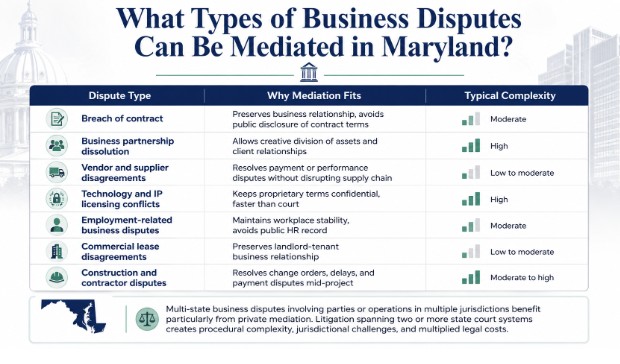
Maryland mediation applies to nearly every category of commercial conflict that does not require emergency injunctive relief or criminal prosecution. Maryland Circuit Courts actively refer business cases to mediation through their ADR programs, and judges routinely encourage parties to attempt mediation before proceeding to trial.
| Dispute Type | Why Mediation Fits | Typical Complexity |
| Breach of contract | Preserves business relationship, avoids public disclosure of contract terms | Moderate |
| Business partnership dissolution | Allows creative division of assets and client relationships | High |
| Vendor and supplier disagreements | Resolves payment or performance disputes without disrupting the supply chain | Low to moderate |
| Technology and IP licensing conflicts | Keeps proprietary terms confidential, faster than court | High |
| Employment-related business disputes | Maintains workplace stability, avoids public HR record | Moderate |
| Commercial lease disagreements | Preserves the landlord-tenant business relationship | Low to moderate |
| Construction and contractor disputes | Resolves change orders, delays, and payment disputes mid-project | Moderate to high |
Multi-state business disputes involving parties or operations in multiple jurisdictions benefit particularly from private mediation. Litigation spanning two or more state court systems creates procedural complexity, jurisdictional challenges, and multiplied legal costs.
A single private mediation session for multi-jurisdictional disputes consolidates the entire resolution process under one neutral.
Maryland Circuit Courts can order parties in civil cases to attend mediation under Title 17 of the Maryland Rules. When the court orders mediation, the ADR coordinator assigns a mediator from the court-approved roster, and the parties pay the court-set rate.
Business owners who initiate private mediation before a lawsuit is filed — or alongside pending litigation — gain three advantages that court-ordered mediation does not provide.
Court-assigned mediators come from the court’s approved roster and may or may not have direct experience in the specific type of commercial dispute at issue.
Private mediation allows the parties to select a mediator whose professional background aligns with the subject matter — a distinction that matters substantially in technology disputes, complex commercial matters, and multi-jurisdictional cases.
Court-ordered mediation must be completed by the deadline set in the scheduling order — typically 180 days from issuance in Baltimore County and approximately one week before the pretrial hearing in Montgomery County.
Private mediation sessions are scheduled around the business owners’ operational needs, not the court’s administrative calendar.
Court-referred mediation follows the procedural framework set by the circuit court’s ADR program. Private mediation allows the parties and the mediator to design the process — including the number of sessions, whether caucuses are used, and whether preliminary information exchange occurs — based on the specific requirements of the dispute.
Earl Acquaviva’s three decades of corporate dispute resolution experience give Maryland business owners a mediator who has navigated the same commercial conflicts they face — from contract performance failures to multi-party technology disputes that cross state lines.
Your business dispute does not have to become part of the public record — contact Acquaviva Mediation to explore resolution options before filing suit.
A mediator with direct corporate dispute-resolution experience identifies leverage for resolution faster than a neutral without a business background.
Earl Acquaviva brings more than 30 years of corporate dispute resolution experience to every mediation session, including direct involvement in the types of commercial conflicts Maryland business owners face — contract performance failures, partnership disagreements, technology disputes, and multi-party commercial matters.
As an approved Business and Technology Mediator in all Maryland Circuit Courts, Acquaviva has conducted successful complex multi-state private mediation sessions involving disputes across Maryland, Virginia, Massachusetts, Pennsylvania, California, Arizona, the District of Columbia, North Carolina, Alabama, Washington, Texas, Ohio, and Wisconsin — 13 jurisdictions total.
That multi-jurisdictional reach matters for Maryland businesses with operations, vendors, or partners outside the state. The mediator already understands how interstate commercial disputes function and where resolution leverage exists.
A mediator who has resolved technology licensing conflicts understands the licensing economics that drive settlement.
A mediator who has handled construction disputes knows how change orders, delay claims, and payment retainage create negotiating dynamics that generic mediation training does not cover.
Subject-matter expertise translates directly to faster resolution and more durable agreements.
Mediation is voluntary, and no party can be forced to accept terms. If the parties do not reach a resolution, all litigation options remain fully available. No rights are waived, no admissions are made, and nothing discussed in mediation can be used in subsequent court proceedings under Maryland’s mediation confidentiality protections.
This makes mediation a low-risk first step. The business owner either resolves the dispute at a fraction of litigation’s cost and timeline, or returns to the litigation track with a clearer understanding of the opposing party’s position, priorities, and settlement range — information that often proves valuable in shaping trial strategy and preventing prolonged disputes.
Even partial agreements reached in mediation narrow the issues that require judicial resolution, reducing the scope, duration, and cost of any subsequent litigation.
Stop letting a commercial dispute drain your time and capital — reach Earl Acquaviva at Acquaviva Mediation to start the resolution process this week.
How much does business mediation cost in Maryland?
Maryland Circuit Courts set court-ordered mediation rates at $200–$300 per hour, depending on case track and county. Private mediation with an experienced business mediator typically costs $200–$500 per hour, with most disputes resolving in 4-12 hours of total session time.
How long does business mediation take in Maryland?
Most Maryland business mediations are completed within one to three sessions over 30 to 60 days. Contested business litigation in Maryland Circuit Courts typically takes 12 to 36 months, making mediation significantly faster for resolving commercial disputes.
Is mediation confidential for business disputes in Maryland?
Maryland Courts and Judicial Proceedings Article § 3-1803 protects mediation communications from disclosure and prohibits their use in subsequent court proceedings. Financial details, trade practices, and settlement terms remain private between the parties.
Can Maryland courts order a business to attend mediation?
Maryland Circuit Courts can order mediation under Title 17 of the Maryland Rules. Judges routinely refer business cases to mediation, though parties cannot be forced to reach an agreement during the process.
What happens if business mediation fails in Maryland?
All litigation rights remain fully available if mediation does not produce a resolution. Nothing discussed during mediation is admissible in court. Partial agreements often narrow disputed issues and reduce subsequent litigation costs.
Can a business owner choose a mediator in Maryland?
Business owners who initiate private mediation select their own mediator. In court-ordered mediation, the ADR coordinator assigns a mediator from the court roster, though parties may request a substitution under Maryland Rule 17-202.
Does mediation work for multi-state business disputes?
Private mediation resolves multi-state business disputes under one neutral without the procedural complexity of litigating across multiple court systems. Earl Acquaviva has mediated complex disputes across 13 states and the District of Columbia.
What types of business disputes are best for mediation in Maryland?
Contract breaches, partnership dissolutions, vendor disputes, technology licensing conflicts, commercial lease disagreements, employment-related business disputes, and construction conflicts all resolve effectively through mediation in Maryland.
Is a mediation agreement legally binding in Maryland?
Mediation agreements become legally binding contracts when properly documented and signed by both parties. For court-referred mediations, the agreement can be submitted to the judge for incorporation into a court order.
Why choose a mediator with corporate experience over a general mediator?
A mediator with corporate dispute resolution experience identifies settlement leverage specific to the business context — contract economics, operational interdependencies, and industry-specific negotiating dynamics — that general mediation training does not cover.